Cajamarca is a colonial town 2,720 meters above sea level which is most infamously know for the place of the last stand of the Inca ruler, Atahualpa, against the Spanish in 1532. Legend has it that Atahualpa and his men were having a big celebration in which they were heavily drinking when they went to meet the Spanish in what they thought would be a friendly encounter. The Spanish instead attacked and the Inca’s, who were not armed, fought only with their bare hands (many of them obviously losing their hands and arms). When Atahualpa saw thousands of his men dead he turned himself into the Spanish and told them if he was released his would fill a room up with gold once and silver twice. The Spanish got their silver and gold and killed him anyways.


From top left: View to Cerro Santa Apolonia, Jon in front of the stairs to the top, view from the Silla del Inca reputed to be the place where the Inca ruler would sit and gaze out over his empire.
One of our favorite tours so far, thanks to our fantastic guide Manuel, was a trip to the 3,000-year-old (pre-Inca) Cumbe Mayo aqueducts thought to be the oldest man-made structure in South America. This canal is approximately 9 km in length carved in volcanic rock to send water from the hills into town. Imagine how advanced they were to build an aqueduct with the perfect pitch using no tools at all. We also learned that the hills of Cajamarca were bare until 15-20 years ago when pine trees were introduced from US and Canada and Eucalyptus trees from Australia.


From top left: Surrounding around which used to be covered in ice, me in front of a cave formed by water, Jon standing at the start of the aqueducts, and view of a piece of the aqueduct.
Up to this point Jon and I had not had many exciting nights out. We basically were up at 6:30 am and passed out by 9:30 pm. I had heard about this not to be missed on-of-a-kind bar and I was determined to go with or without Jon. He of course was not going to let me traipse around the city at night alone so he grudgingly followed me. We headed to the ally that the bar was on and knocked on the unmarked door. An ancient man, Victor, opened the door to his home and lead us to the back yard which he had converted into several levels of drinking areas filled with mismatched tables, secret nooks and memorabilia. I opted for the house drink macerado, which is a delicious liquor made from fermenting tomatillo and sugar. Three hours later I had to tell Jon “no mas” were heading home. As we went out into the street we could have been in Boston. There were people standing in line for a club and our choice of street meat.


From top left: Jon with our two new friends we made at the bar (they only spoke Spanish), me with my pitcher of macerado, and Jon consuming a beer even with the warning sticker.
Feeling on a role the next day I convinced Jon to try another thermal bath, Banos del Inca, before our 1 pm bus by stating it would help his hangover. We encountered an employee when we arrived who lead us right in, skipping all the lines and directly to our own thermal heated private bath. We finished at 11 am giving us an hour to get back to the hotel, shower and pack up. I thought it would be better to take a combi (mini-bus), as I had not yet learned my lesson on how slow buses were. After forty-five minutes of stopping every 10 feet we jumped off and walked the rest of the way back to our hotel arriving at 11:55 giving us no time to shower and 5 minutes to pack. We quickly jumped in a cab to take us to the bus station and Jon lovingly put his hand on my leg and said “thank god we saved that $3 by taking the combi instead of a taxi.”


Picture of me in front of the ancient baths no longer used and a picture of the gardens with surrounding private baths.
What we ate, Cajamarca is known for its dairy products. I was able to sample a few of the cheeses which were mild and similar to a queso fresco. We tried a delicious stew served with lime and a home-made hot sauce which was outstanding. I also bought some little yellow tart tomatillos, I have had them back home but they are called husked cherries. The best part about the Cajamarca restaurants we visited was that I was able to eat some outstanding food while singing along to the best of the 80’s soundtrack.
Where we stayed, Hostal Monumental, a big cement building in the colonial center of town with clean rooms that opened up onto an internal covered courtyard which let in a lot of light. We had a private room with a bathroom for $40 a night not including breakfast. We winged it on this one and this was the fourth place we stopped at. The first which was lovely was full, the second too expensive and the third reminded us of the dark room in Iquitos.
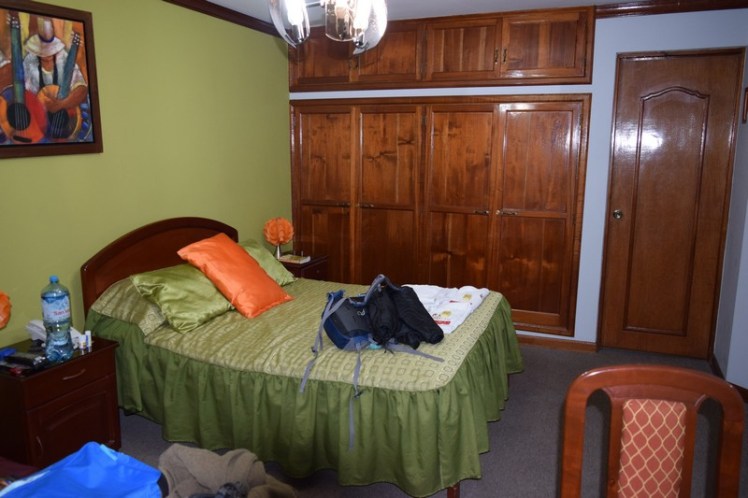
Our hotel room.
 Journey with Christina